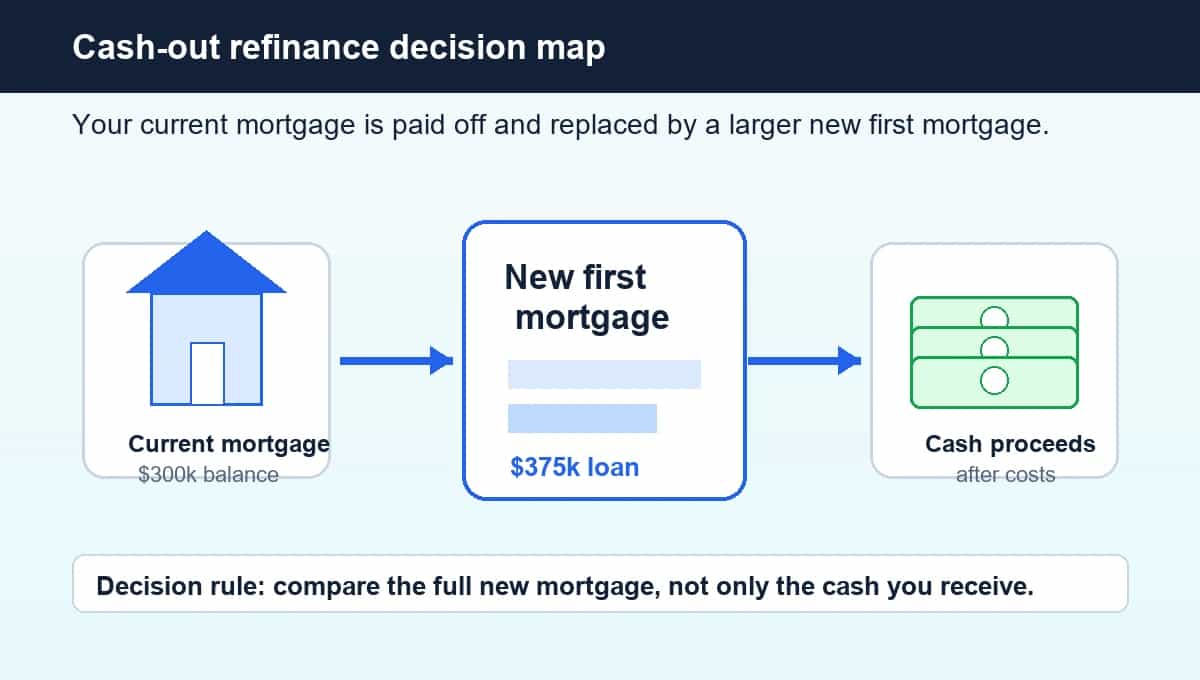
A cash-out refinance can make sense in 2026, but only for a narrower group of homeowners than the ads make it sound. The reason is simple: a cash-out refinance does not just borrow against equity. It replaces your current first mortgage with a larger new mortgage, then gives you part of the difference in cash.
That structure matters when many homeowners still have older first-mortgage rates that are lower than current market rates. As of July 23, 2026, Freddie Mac's Primary Mortgage Market Survey showed the 30-year fixed-rate mortgage averaging 6.58% and the 15-year fixed-rate mortgage averaging 5.96%. If your current first mortgage is far below that, refinancing the whole balance to access cash may be expensive even if the cash solves a real problem.
The better question is not, "Can I get cash out?" The better question is, "Is replacing my first mortgage the cleanest way to borrow, or should I use a second mortgage, HELOC, personal loan, or wait?"
Key Takeaways
- A cash-out refinance replaces your current first mortgage with a larger new loan and returns some equity to you at closing.
- It can work when the new rate, closing costs, loan term, and cash purpose improve your full financial position.
- It is weaker when you would replace a low first-mortgage rate with a higher rate on the entire balance.
- CFPB research shows cash-out borrowers often use funds to pay other debts, but converting unsecured debt into mortgage debt can increase foreclosure risk.
- Compare a cash-out refinance against a HELOC, home equity loan, and rate-and-term refinance before choosing.
- Keep an equity cushion. CFPB consumer guidance says lenders typically require homeowners to keep at least 10% to 20% of home value as equity when using cash-out refinance, home equity loan, or HELOC options.
The short answer: use cash-out only when the whole loan still works
A cash-out refinance is worth considering when three things are true: you need a meaningful lump sum, you have enough equity after borrowing, and the new first mortgage still makes sense after costs.
That last part is where many borrowers get tripped up. A cash-out refinance can look attractive because mortgage rates may be lower than credit card or personal loan rates. But if the new loan reprices your full mortgage balance, the cost is not limited to the cash you take out. You are also changing the rate, term, and payoff path on the money you already owed.
A cash-out refinance is not just a home-equity loan with a different label. It is a new first mortgage with cash attached.
If your current mortgage rate is near or above current market levels, the math may be reasonable. If your current rate is 3.25% and the new rate is near the mid-6% range, the cash-out option has to clear a much higher bar. In that case, a second mortgage may preserve the low first mortgage and price only the new borrowing separately.
Use the Ratespedia guide on home equity loans vs. HELOCs if your main goal is borrowing against equity while leaving the first mortgage alone.
What is a cash-out refinance?
A cash-out refinance replaces your existing mortgage with a new mortgage that is larger than what you currently owe. The old loan is paid off. You receive part of the extra loan amount as cash after closing costs, prepaid items, and any required payoffs are handled.
The CFPB's home-equity guide describes cash-out refinance proceeds as money received all at once when the loan is taken out. It also explains that the new mortgage includes the amount borrowed and fees from the cash-out refinance, plus the money used to pay off the previous mortgage.
Here is the simplified structure:
| Current situation | Cash-out refinance result |
|---|---|
| Home value: $500,000 | Home value still matters for approval and equity |
| Current mortgage balance: $300,000 | Current mortgage is paid off |
| New loan amount: $375,000 | New first mortgage replaces the old one |
| Example closing costs and escrows: $8,000 | Costs reduce cash available or increase financing needs |
| Estimated cash before other payoffs: $67,000 | Cash depends on final payoff, costs, and lender limits |
That example is not a quote. The exact outcome depends on appraised value, payoff balance, loan program, credit score, debt-to-income ratio, occupancy, property type, and lender rules.
Why the 2026 rate environment changes the decision
The cash-out question is more complicated in 2026 because first-lien mortgage rates and home-equity rates are both still elevated by the standards of 2020 and 2021.
Freddie Mac's July 23, 2026 PMMS average of 6.58% for a 30-year fixed mortgage is useful first-lien context. For HELOCs, many lenders price from the prime rate plus or minus a margin. The Federal Reserve's H.15 Selected Interest Rates release showed the bank prime loan rate at 6.75% for July 23, 2026.
That does not mean a HELOC is automatically more expensive or a cash-out refinance is automatically cheaper. A HELOC may price only the new debt but usually has a variable rate. A cash-out refinance may have a lower rate than a HELOC, but that rate applies to the entire first-mortgage balance.
6.58%
5.96%
6.75%
+2.0%
Home values also affect the amount of usable equity. The FHFA House Price Index release dated June 30, 2026 said U.S. house prices were down 0.1% in April from the prior month but up 2.0% from April 2025 to April 2026. That is a reminder to use a current valuation, not a hopeful estimate from a peak market.
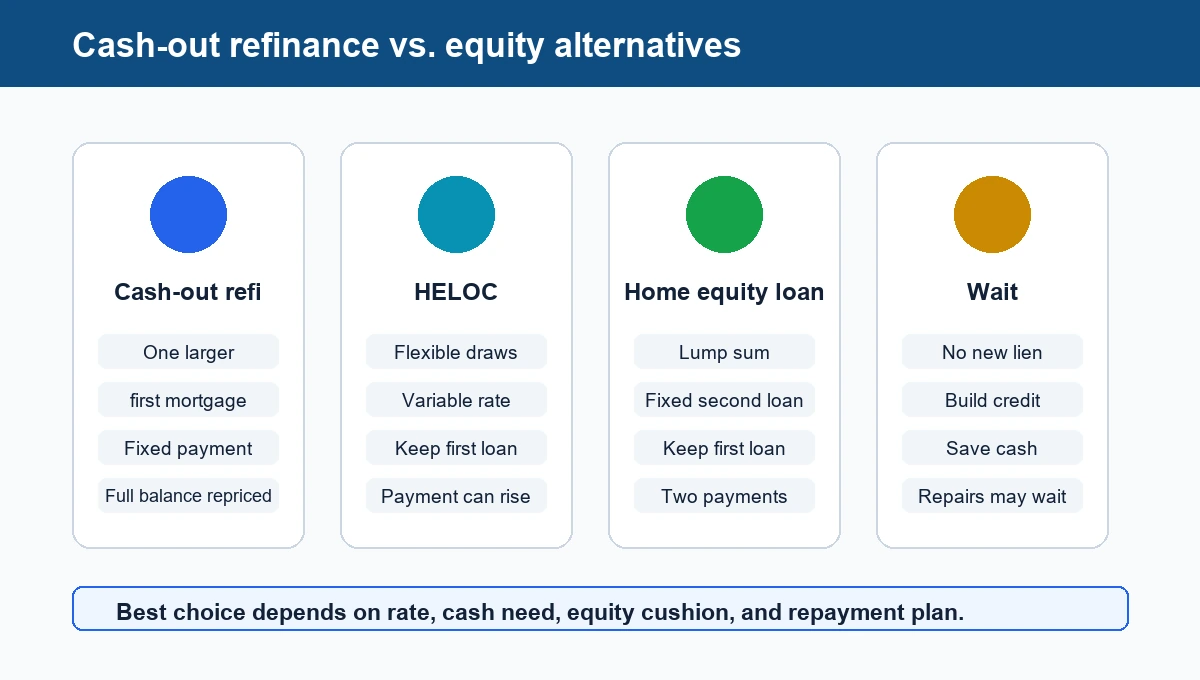
Cash-out refinance vs. HELOC vs. home equity loan
The best home-equity option depends on what you need the money for, how certain the amount is, how long you will carry the debt, and whether protecting your current first mortgage is valuable.
| Option | Best fit | Main advantage | Main risk |
|---|---|---|---|
| Cash-out refinance | Large lump sum and first mortgage still improves or stays acceptable | One mortgage payment and a long fixed repayment schedule | Reprices the entire first mortgage balance |
| HELOC | Phased project, uncertain borrowing amount, or short-term liquidity | Borrow, repay, and borrow again during the draw period | Variable rate and payment uncertainty |
| Home equity loan | Known lump-sum expense with payment certainty | Fixed second mortgage without touching the first mortgage | Separate payment and closing costs |
| Rate-and-term refinance | Lower rate or better term with little or no cash out | Focuses on payment, term, or mortgage insurance improvement | Does not solve a separate cash need |
The CFPB explains that a home equity loan gives you a lump sum, while a HELOC lets you borrow multiple times from an available limit. It also notes that both are second mortgages when you already have a first mortgage.
That difference is practical. If you need $75,000 at once and your current first mortgage is already close to market, a cash-out refinance may be clean. If you need flexible draws and your first mortgage is much lower than market, a HELOC may be easier to justify.
When cash-out refinancing can make sense
Cash-out refinancing can be reasonable when the cash has a clear purpose and the new mortgage improves or preserves your larger plan.
Strong use cases usually have one of these profiles:
The debt-consolidation case deserves extra care. A 20% or higher credit card rate may make a mortgage-rate cash-out option feel obvious, but the debt changes character. You may turn unsecured revolving debt into debt secured by your home.
CFPB's 2025 cash-out refinance report found that cash-out borrowers between 2014 and 2021 often used funds to pay down credit card and auto loan debt. It also reported that credit scores improved sharply after refinance, then softened over the following year while generally remaining above pre-refinance levels.
When a cash-out refinance is probably the wrong tool
A cash-out refinance is weaker when it solves the cash problem by damaging the mortgage you already have.
Be cautious if any of these apply:
- Your current first mortgage is far below current market rates.
- You only need a small amount of cash.
- You are using the money for discretionary spending without a repayment plan.
- You plan to sell or refinance again before you recover the closing costs.
- The new payment depends on optimistic assumptions about future income.
- The lender is pushing points, credits, or a bigger loan amount you did not ask for.
The Ratespedia guide on refinance break-even math is useful here. Even if your main goal is cash, you still need to know how long it takes the new structure to pay for itself compared with the alternatives.
How much equity do you need?
Lenders do not usually let you convert all home equity into cash. They set loan-to-value or combined loan-to-value limits so the home still has an equity cushion after the transaction.
The CFPB home-equity guide says that with a cash-out refinance, home equity loan, or HELOC, lenders typically require you to keep at least 10% to 20% of your home value as equity. Many conventional cash-out scenarios are commonly structured around an 80% loan-to-value ceiling for owner-occupied properties, though exact limits vary by program, occupancy, property type, credit profile, and lender.
Use this quick estimate:
Estimated maximum loan amount = home value x allowed LTV
Potential cash before costs = maximum loan amount - current mortgage payoff
If your home is worth $500,000 and the allowed LTV is 80%, the estimated maximum first mortgage is $400,000. If your payoff is $310,000, the theoretical gap is $90,000 before closing costs, prepaid items, and payoff adjustments.
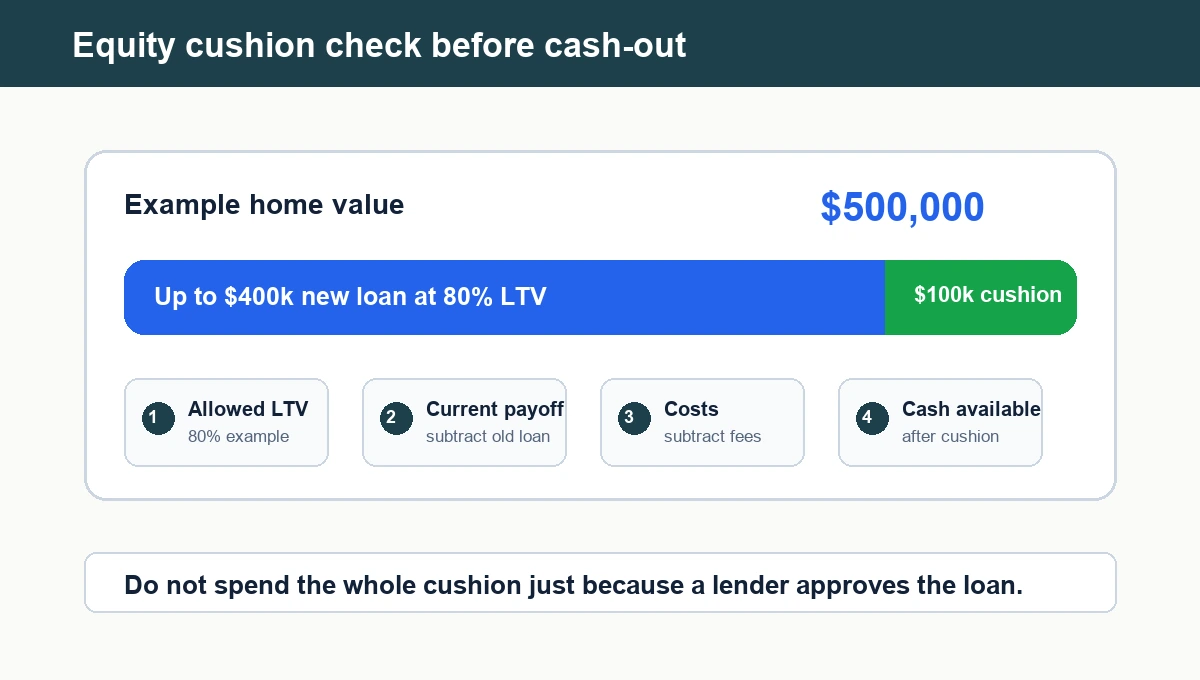
Do not spend the whole cushion just because a lender approves it. Selling costs, repairs, market movement, and future credit needs can make thin equity uncomfortable.
Closing costs, points, and lender credits still matter
A cash-out refinance can include origination fees, appraisal costs, title charges, recording costs, prepaid interest, escrow setup, discount points, and other closing charges.
The CFPB Loan Estimate explainer says the best way to tell if you have a competitive loan offer is to compare Loan Estimates from other lenders and compare origination charges. It also notes that the total matters because lenders may itemize charges differently.
Points and lender credits are another place borrowers need clarity. The CFPB guidance on points and lender credits explains that points can lower the rate in exchange for more upfront cost, while lender credits lower upfront costs in exchange for a higher rate.
For cash-out refinancing, ask each lender for the same scenario:
If the lowest-rate quote only wins because it includes expensive points, use the Ratespedia guide on mortgage points and seller credits to think through the break-even period.
Should you use cash-out refinance to pay debt?
Cash-out refinancing for debt consolidation can work when it reduces total interest, lowers required monthly payments, and comes with a real behavior change. It can fail when it frees up credit cards and the balances come back.
Start with these questions:
- What debts are being paid off?
- What are their rates, minimum payments, and payoff dates?
- What will the new mortgage payment be?
- How much longer will the mortgage last after the refinance?
- Will any credit lines be closed, reduced, or frozen from new spending?
- What happens if income drops or the home needs repairs?
The home is collateral. CFPB's home-equity guide warns that failing to make payments or meet loan requirements can put the home at risk of foreclosure. That risk may be acceptable for necessary repairs or a carefully managed debt plan. It is harder to justify for spending that does not improve the household's balance sheet.
A practical cash-out refinance decision framework
Use this sequence before applying:
If a quote looks surprisingly low, slow down. Verify the lender, points, APR, lock status, and cash-out amount. The Ratespedia article Is this mortgage offer a scam? walks through the verification steps.
FAQ: cash-out refinance in 2026
Is a cash-out refinance worth it in 2026?
It can be worth it if replacing the first mortgage does not create a major cost penalty, your cash use is specific, and the new payment fits comfortably. It is weaker if you have a low first-mortgage rate and only need to borrow a modest amount.
Is a cash-out refinance better than a HELOC?
Not always. A cash-out refinance may offer one fixed mortgage payment, but it reprices the full first-mortgage balance. A HELOC usually leaves the first mortgage alone and lets you borrow only what you need, but the rate is often variable.
How much cash can I take out?
It depends on home value, current payoff, allowed LTV or CLTV, occupancy, credit, income, property type, and program rules. A useful estimate is home value multiplied by allowed LTV, minus the current payoff and transaction costs.
Can I use cash-out refinance money to pay credit cards?
Yes, but be careful. It may reduce monthly payments and interest costs, but it can also turn unsecured card debt into mortgage debt secured by your home. Build a plan to prevent balances from returning.
Bottom line
A cash-out refinance in 2026 is best for homeowners who need a clear lump sum, have enough equity, and can accept the new first-mortgage rate, term, payment, and closing costs. It is not automatically the cheapest way to use home equity, especially if your existing mortgage rate is well below current market levels.
Start with your current mortgage, your actual cash need, and your equity cushion. Then compare the cash-out refinance against a HELOC, home equity loan, and waiting. The right answer is the option that solves the cash need without weakening the rest of your housing plan.
Ratespedia's resources and calculators can help you pressure-test payments before you choose. If you want to verify Ratespedia's licensing, start with the license page.
Compare home-equity options before you refinance
Use your current mortgage, cash need, equity cushion, and target payment to compare refinance and second-mortgage options.
Ratespedia LLC is a licensed mortgage broker. NMLS # 2796610. This article is educational and is not legal, credit, tax, or financial advice. Mortgage rates, HELOC rates, prime-rate margins, home values, loan-to-value limits, points, lender credits, closing costs, tax rules, and underwriting requirements can change. Review your Loan Estimate, payoff statement, and Closing Disclosure before making a mortgage decision.

Written by
Chad Harter
CEO, Ratespedia | NMLS #858728
Chad Harter is the founder and CEO of Ratespedia, a licensed mortgage brokerage helping borrowers across the United States find competitive rates and understand their options. With over a decade of experience in mortgage lending and financial services, Chad built Ratespedia to bring transparency and simplicity to one of the most important financial decisions people make. He writes on mortgage markets, personal finance, and borrower strategy.