A mortgage interest rate tells you the annual rate charged on the amount you borrow. A mortgage annual percentage rate (APR) is a broader measure that combines the interest rate with certain points, broker fees, and other finance charges. That makes APR useful when you are comparing similar mortgage offers, but it is not a substitute for checking the monthly payment, cash to close, points or credits, and how long you expect to keep the loan.
The practical rule is simple: use the interest rate to understand the pricing that drives principal-and-interest payments, and use APR to expose more of the borrowing cost behind that rate. Then compare the dollar costs on the Loan Estimate before choosing.
That distinction matters in August 2026 because mortgage pricing is still moving enough that two quotes issued on different days may not be directly comparable. Freddie Mac reported through the Associated Press that the average 30-year fixed rate was 6.67% for the week ending August 13, 2026, down slightly from 6.69% the prior week. A national weekly average is context, not the rate or APR any individual borrower will receive.
Key Takeaways
- The interest rate is the annual cost of borrowing the principal and does not include loan fees.
- APR is broader. The CFPB says it reflects the interest rate plus points, mortgage broker fees, and other charges used to obtain the loan.
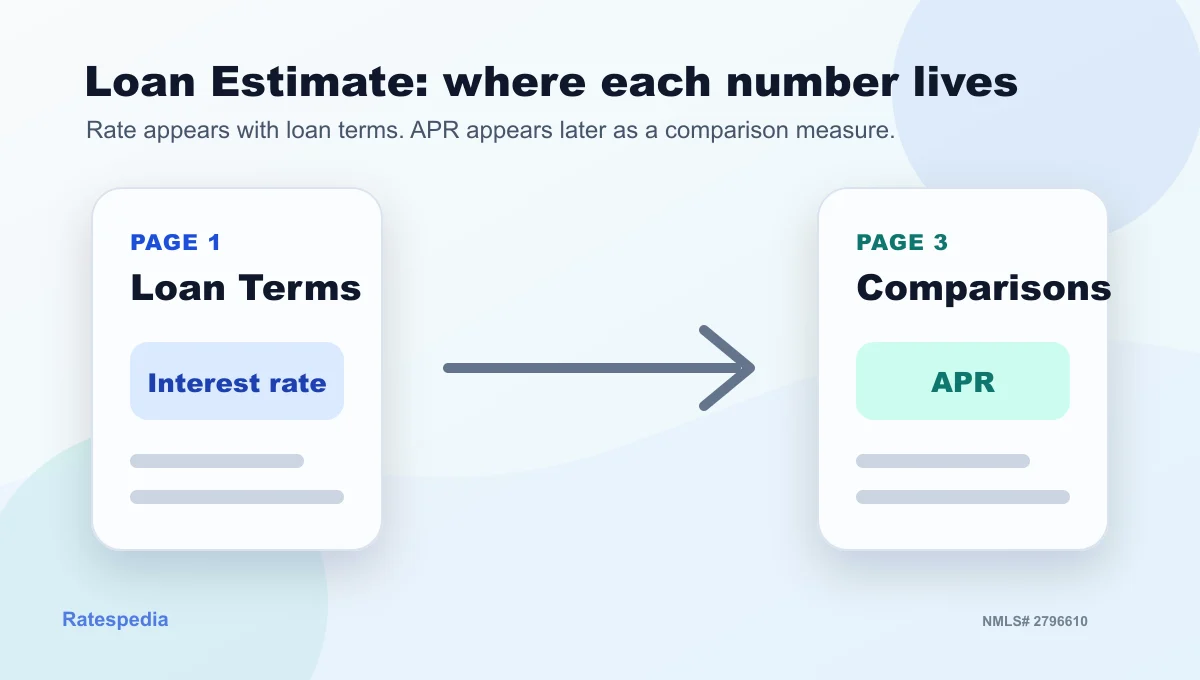
- On a standard Loan Estimate, the interest rate is on page 1 under Loan Terms and APR is on page 3 under Comparisons.
- A lower APR can be a useful signal when you are comparing truly similar loans, but APR alone does not tell you the best monthly payment, cash requirement, or adjustable-rate risk.
- Compare Loan Estimates issued close together with the same loan amount, term, loan type, and rate-lock assumptions.
- Page 3's five-year comparison can turn percentage differences into dollars and is often more useful than staring at APR alone.
Interest rate vs. APR: the shortest useful definition
The Consumer Financial Protection Bureau defines the interest rate as the yearly cost of borrowing money, expressed as a percentage, without the fees and other charges associated with obtaining the loan.
APR is designed to capture more. The same CFPB guidance says mortgage APR reflects the interest rate plus points, mortgage broker fees, and other charges. Because those costs are folded into the APR calculation, APR is usually higher than the note rate.
| Number | What it mainly tells you | What it does not tell you by itself |
|---|---|---|
| Interest rate | The rate used to calculate interest on the loan balance | Upfront finance charges, points, broader acquisition cost |
| APR | A broader annualized borrowing-cost measure that includes the rate and certain charges | Your exact cash to close, total monthly housing payment, or whether an ARM could later reach a much higher rate |
| Cash to close | The estimated amount you need to bring to closing | The long-term borrowing cost |
| Five-year comparison | A dollar-based view of payments, principal reduction, interest and fees over the first five years | What happens after year five or after an ARM adjustment |
The mistake is treating one column as the universal winner. Each answers a different question.
The rate tells you how the loan accrues interest. APR helps reveal the price attached to getting that loan. The better comparison uses both, plus actual dollars.
Where are the interest rate and APR on a Loan Estimate?
A mortgage Loan Estimate is a standardized three-page form. The CFPB's Loan Estimate explainer shows the interest rate on page 1 in the Loan Terms section. APR appears on page 3 in the Comparisons section.
That placement is intentional. Page 1 answers the immediate loan-terms questions: loan amount, interest rate, monthly principal and interest, whether the rate can change, and other core features. Page 3 is built to help you compare the cost of one offer with another.
The CFPB says lenders generally must provide a Loan Estimate within three business days after receiving a mortgage application. The standardized format matters because a verbal quote, rate advertisement, text message, or screenshot may omit the fees and assumptions that make an offer expensive.
If you are still gathering quotes, the Ratespedia guide on how to get a lower mortgage rate covers the borrower factors and shopping steps that can change the rate itself.
Why can two loans have the same interest rate but different APRs?
Because the cost of obtaining the loans can be different.
Imagine two lenders quote the same fixed interest rate and the same loan amount. One charges more in origination fees or discount points. The other charges less. If the charges included in the APR calculation differ, the APRs can differ even though the note rates match.
That is why the headline rate is incomplete. A lender can price a lower rate by charging points upfront. Another lender can reduce upfront cost with a lender credit while offering a higher rate. The CFPB's points and lender-credits guidance describes that basic tradeoff: points generally mean paying more at closing for a lower rate, while lender credits generally reduce closing costs in exchange for a higher rate.
Ratespedia's guide to mortgage points, seller credits, and buydowns goes deeper into that pricing decision.
Is the lowest APR always the best mortgage?
No.
For similar fixed-rate loans with the same amount and term, a lower APR can indicate a lower broad borrowing cost. But the CFPB specifically warns against using APR alone when comparing unlike products.
For adjustable-rate mortgages, the CFPB notes that APR does not reflect the maximum interest rate the loan could reach. It also cautions borrowers when comparing fixed-rate loans with ARMs, different ARM structures, or closed-end loans with home equity lines of credit because the calculations and future-rate assumptions differ.
Your expected holding period matters too. APR annualizes certain costs over the loan's assumed life. If one offer requires a large upfront point charge to lower the rate, that pricing may look attractive over a long enough period but may not recover its upfront cost if you sell or refinance relatively soon.
For that reason, "lowest APR wins" is too simplistic.
What should you compare besides APR?
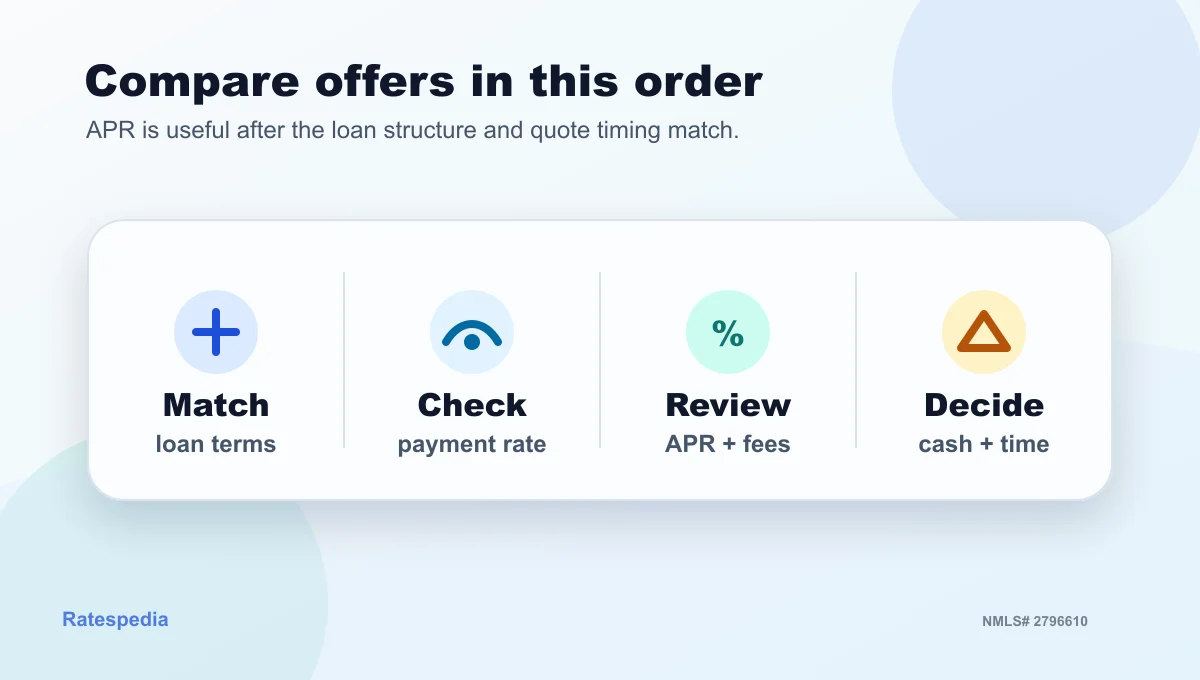
Start with the standardized Loan Estimate and keep the loan structures aligned.
The CFPB's current loan-offer comparison guidance recommends reviewing multiple Loan Estimates and comparing the loan amount, interest rate, monthly principal-and-interest payment, and the page 3 comparison information. It also notes that interest rates can change daily, so estimates issued on different days may reflect different market conditions rather than different lender margins.
Use this order:
If upfront cash is the confusing part, see Ratespedia's guide to closing costs on a house in 2026.
The five-year comparison can be more intuitive than APR
APR is useful, but it is still an annualized percentage. The Loan Estimate also gives you a way to compare dollar cost.
The CFPB explains that page 3 includes an "In 5 years" comparison. The first number is the total amount you will have paid over five years, including principal. The second is the amount of principal you will have paid off. Subtracting the principal paid from the total paid gives you the amount of interest and fees paid over that five-year period.
That can expose a tradeoff that APR alone makes harder to visualize.
For example, one loan may require more upfront points but produce a lower monthly payment. Another may cost less at closing but carry a higher rate. The five-year cost gives you a common dollar window for comparing those structures, provided the loans themselves are comparable.
For an ARM, the CFPB warns that the five-year comparison assumes the interest rate stays the same. If the rate adjusts upward, actual borrowing cost can be higher.
APR is a standardized Truth in Lending disclosure
APR is not just a lender-created marketing metric. Regulation Z §1026.22 governs APR determination for closed-end credit, while Appendix J addresses computation methods. Use the disclosed APR on official Loan Estimates instead of trying to reverse-engineer it from an advertisement.
How points and lender credits change the rate-versus-APR story
Points and credits are where many borrowers misread the comparison.
Paying discount points can reduce the interest rate while increasing upfront cost. A lender credit can reduce upfront cost while increasing the rate. Both choices can be legitimate, but they solve different problems.
A buyer who plans to keep the same mortgage for many years may care more about the break-even period on points. A buyer who expects to refinance, relocate, or preserve cash may care more about the upfront-cost tradeoff. Neither goal is captured by "lowest rate" alone.
Ask a lender to show comparable pricing options for the same loan, such as:
- A version with no discount points and no lender credit.
- A version with points and the corresponding lower rate.
- A version with a lender credit and the corresponding higher rate.
Then compare APR, cash to close, monthly principal and interest, and five-year cost.
What does the current 2026 rate environment change?
It does not change what APR means, but it makes quote timing more important.
On August 13, 2026, Freddie Mac's weekly 30-year fixed-rate average was reported at 6.67%, down two basis points from the prior week, according to the Associated Press. Freddie Mac's Primary Mortgage Market Survey is based on thousands of conventional conforming purchase-loan applications submitted through Loan Product Advisor and is published weekly.
That national average is not an individual offer. The useful takeaway is narrower: when the market is moving, compare lender offers issued as close together as practical. If you are near closing, review Ratespedia's mortgage rate-lock guide so you know whether two quotes are actually locked on comparable terms.
FAQ: mortgage APR vs. interest rate
Why is my mortgage APR higher than my interest rate?
APR usually exceeds the interest rate because it incorporates the rate plus certain costs used to obtain the mortgage, such as points, mortgage broker fees, and other finance charges. A larger spread can be a signal to inspect the Loan Estimate for upfront costs, but the spread alone does not identify which charge caused it.
Should I compare mortgages by interest rate or APR?
Compare both. Use interest rate and principal-and-interest payment to understand the core monthly borrowing cost, then use APR, points, lender credits, cash to close, and the five-year comparison to understand broader cost.
Where is APR on the Loan Estimate?
APR is on page 3 in the Comparisons section. The interest rate is on page 1 under Loan Terms. The CFPB's interactive Loan Estimate explainer shows both locations.
Can a loan with a higher interest rate have a lower APR?
It can when the overall fee structure differs enough, because APR reflects more than the note rate. Do not infer that outcome from the rate alone. Compare official Loan Estimates for the same loan type, amount, term, and timing.
Does mortgage APR include every closing cost?
No. APR is based on the finance charges included under Truth in Lending rules, not every dollar that may appear in cash to close. Taxes, insurance, escrow funding, and other transaction items can affect cash to close without functioning like lender finance charges.
Is APR reliable for an adjustable-rate mortgage?
It has limitations. The CFPB warns that an ARM's APR does not show the maximum interest rate the loan can reach. Review the ARM adjustment terms and worst-case payment information instead of relying on APR alone.
Bottom line
For a mortgage, the interest rate and APR are complementary, not competing, numbers.
Use the interest rate to understand the loan's basic interest pricing and principal-and-interest payment. Use APR to broaden the comparison to include certain loan-acquisition costs. Then use the Loan Estimate's points, lender credits, cash-to-close figure, and five-year comparison to decide whether the offer actually fits your timeline and budget.
Ratespedia's free mortgage calculators and comparison tools can help you model payment and borrowing-cost tradeoffs before you commit. When you are ready to compare a real scenario, start with the complete loan structure rather than a headline rate.
Compare the whole mortgage offer
Look beyond the headline rate. Compare payment, points, credits, APR, cash to close, and loan structure for your mortgage scenario.
Ratespedia LLC is a licensed mortgage broker. NMLS# 2796610. This article is educational and is not legal, credit, tax, or financial advice. Mortgage rates, APRs, fees, points, credits, program guidelines, disclosures, and underwriting requirements can change. Review your Loan Estimate and applicable loan documents before making a mortgage decision.

Written by
Chad Harter
CEO, Ratespedia | NMLS# 2796610
Chad Harter is the founder and CEO of Ratespedia, a licensed mortgage brokerage helping borrowers across the United States find competitive rates and understand their options. With over a decade of experience in mortgage lending and financial services, Chad built Ratespedia to bring transparency and simplicity to one of the most important financial decisions people make. He writes on mortgage markets, personal finance, and borrower strategy.