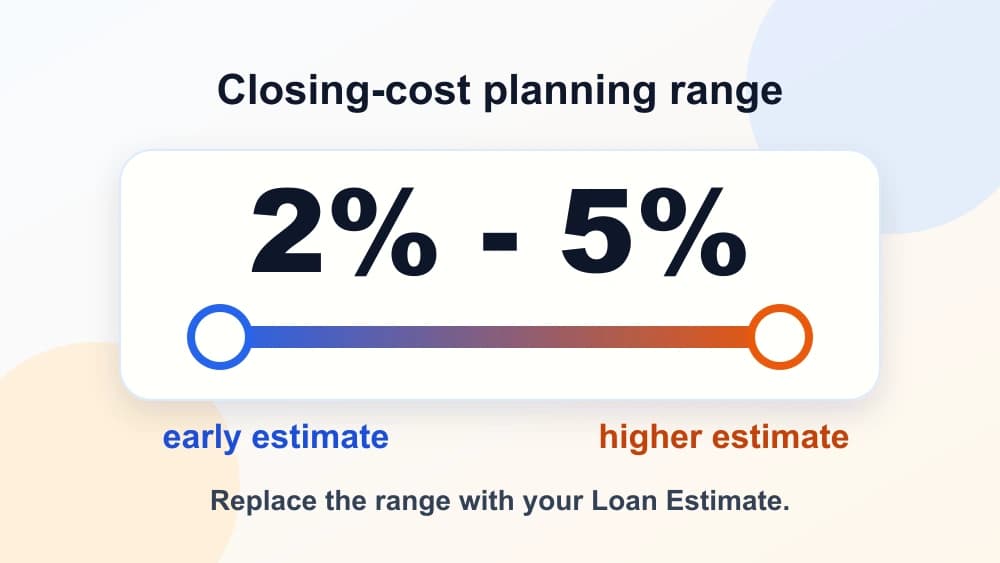
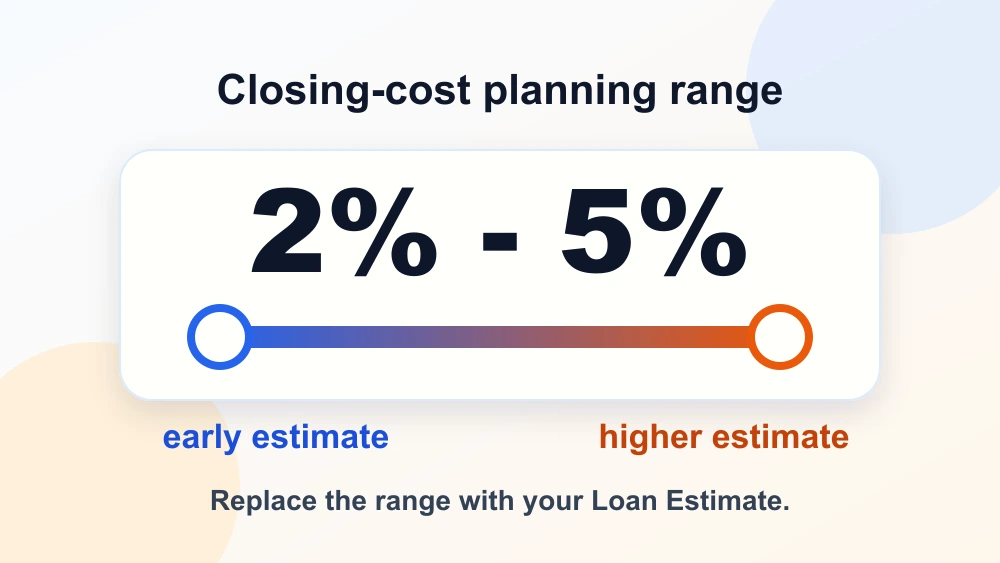
Closing costs on a house are commonly estimated at roughly 2% to 5%, but there is no single percentage that tells every buyer what to bring to closing. The Consumer Financial Protection Bureau uses 2% to 5% of the purchase price as an early budgeting range. Fannie Mae describes a typical range of 2% to 5% of the mortgage amount. Those are planning ranges, not quotes.
Your actual number depends on the home price, loan amount, loan program, lender charges, third-party settlement services, property location, taxes, insurance, escrow setup, discount points, and credits. Two buyers purchasing similarly priced homes can therefore have very different closing numbers.
The most useful distinction is this: closing costs are not the same as your down payment, and they are not the same as cash to close. The final cash-to-close figure combines the parts of the transaction you owe with deposits, credits, financing, and other adjustments.
Key Takeaways
- CFPB consumer guidance uses 2% to 5% of purchase price as a rough early estimate for closing costs, excluding the down payment.
- Fannie Mae uses a similar 2% to 5% planning range based on the mortgage amount, which shows why the percentage is only a budgeting shortcut.
- Closing costs can include lender charges, required third-party services, title and settlement costs, government fees, prepaids, and initial escrow funding when applicable.
- Cash to close is the amount you actually need to deliver at closing after the down payment, costs, deposits, seller credits, lender credits, and other adjustments are reconciled.
- Compare Loan Estimates from multiple lenders using the same loan structure. A low rate can come with expensive points, while lender credits can reduce upfront costs in exchange for a higher rate.
- Some services can be shopped independently. Use the Loan Estimate to identify the services for which the lender allows provider choice.
The short answer: budget 2% to 5%, then replace the estimate with real numbers
A 2% to 5% range is useful before you have a property and a Loan Estimate. It is not precise enough once you are under contract.
For a $400,000 purchase, the CFPB planning range would suggest roughly $8,000 to $20,000 of closing costs before the down payment. If you instead apply Fannie Mae's loan-based range to a $360,000 mortgage, the rough estimate would be $7,200 to $18,000. Neither calculation is a lender quote, and neither should be treated as the exact amount you will need.
A closing-cost percentage is a planning tool. Your Loan Estimate and Closing Disclosure are the transaction documents that turn the estimate into actual line items.
The difference matters because a buyer with a smaller loan may still face location-specific taxes, title charges, prepaid insurance, escrow funding, or other expenses that do not shrink in perfect proportion to the loan amount. A buyer paying discount points can also have materially higher upfront costs than a buyer taking a lender credit.
What is included in mortgage closing costs?
The CFPB's Loan Estimate guidance explains that the standardized three-page form includes the estimated interest rate, monthly payment, total closing costs, and estimates for taxes and insurance. Because lenders use the same form, buyers can compare offers more consistently.
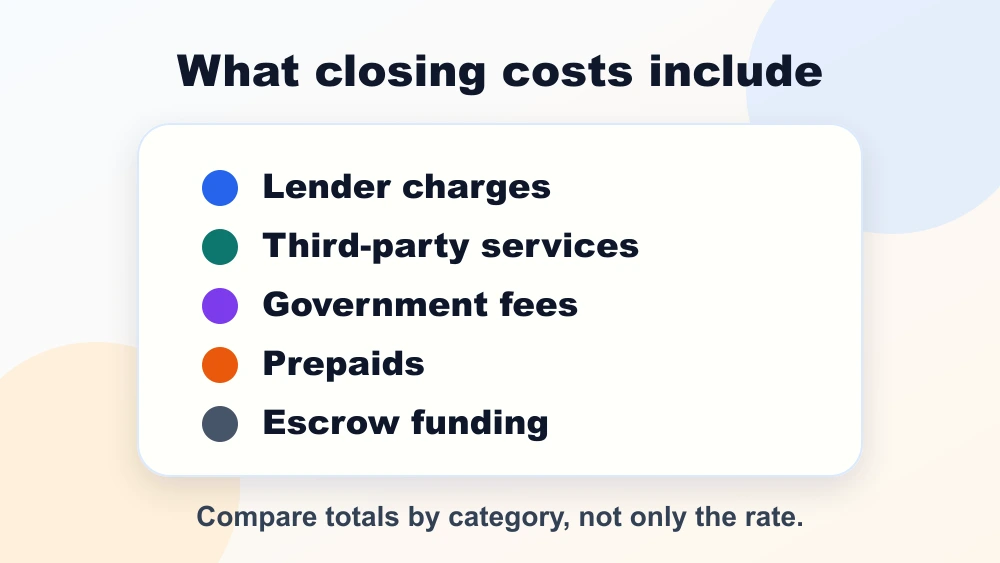
Common categories include:
| Cost category | What it can include | What to compare |
|---|---|---|
| Origination charges | Application, origination, underwriting, processing, verification, or rate-related charges | Compare the total lender-controlled charges across Loan Estimates |
| Points | Upfront charge paid for a lower interest rate | Compare the same rate and point structure, not just the headline rate |
| Required third-party services | Appraisal, credit, flood, title, settlement, or other required services depending on the loan | Identify which provider is selected by the lender and which services you may shop |
| Taxes and government fees | Recording, transfer, and other jurisdiction-specific charges | Verify the estimate and applicable location |
| Prepaids | Daily interest, homeowners insurance, and other advance payments | Check dates and assumptions rather than treating them as lender profit |
| Initial escrow payment | Funds placed into escrow for future taxes and insurance | Verify the calculation and required reserve amount |
Fannie Mae's current consumer calculator similarly identifies origination, settlement and title, third-party, and taxes or government charges as common closing-cost groups. The exact labels can differ between tools and transaction documents, so compare the totals and the purpose of each charge rather than relying on one fee name.
That is one reason comparison shopping works best with standardized Loan Estimates instead of screenshots, verbal quotes, or advertised rates.
Closing costs vs. cash to close: what is the difference?
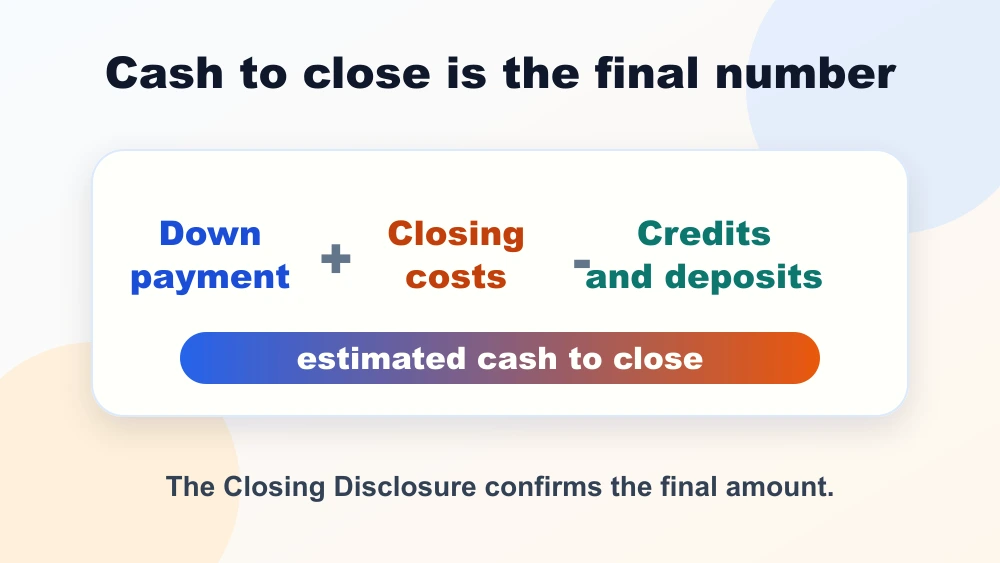
Closing costs are the upfront costs associated with the mortgage and real estate transaction, excluding the down payment. Cash to close is the net amount you still have to provide at closing after the transaction's debits and credits are reconciled.
The CFPB's Closing Disclosure explainer separates total closing costs from cash to close so borrowers can compare the final figures with their Loan Estimate before settlement.
A simplified purchase might look like this:
| Example item | Amount |
|---|---|
| Down payment | $40,000 |
| Closing costs and prepaids | $12,000 |
| Earnest-money deposit already paid | -$5,000 |
| Seller credit | -$4,000 |
| Estimated cash to close | $43,000 |
This example is illustrative. Purchase-contract adjustments, lender credits, financed charges where permitted, tax prorations, deposits, and other items can change the final figure.
If upfront cash is your main constraint, the Ratespedia guide to down payment assistance for first-time homebuyers explains how assistance, gifts, credits, and low-down-payment programs can interact.
Which closing costs can you actually reduce?
Not every line item is equally negotiable. Focus first on costs controlled by the lender or a provider you are allowed to choose.
The CFPB recommends comparing Loan Estimates from multiple lenders. Its mortgage-shopping guidance also distinguishes services that borrowers can shop for from services selected by the lender. Where provider choice is allowed, obtaining another quote can reduce cost without changing the mortgage itself.
Fannie Mae's closing-cost calculator also encourages borrowers to shop around for loan terms and notes that some fees can be reduced through comparison shopping or negotiation. Taxes and government charges, by contrast, are driven by the applicable jurisdiction rather than ordinary lender pricing.
Seller credits can lower cash due, but they are part of the deal
A seller credit is money the seller agrees to contribute toward eligible buyer costs. It can reduce the buyer's cash requirement, but it does not make the underlying cost disappear. The credit is part of the negotiated purchase transaction and remains subject to loan-program and underwriting rules.
Seller credits can be especially useful when a buyer has enough income to support the mortgage but wants to preserve cash after closing. In another negotiation, a lower purchase price might be more valuable. The tradeoff depends on the loan, appraisal, available cash, local market, and how long you expect to own the home.
Ratespedia's guide to mortgage points and seller credits goes deeper into the difference between a price concession, a seller-paid closing-cost credit, discount points, and lender credits.
Lender credits lower upfront costs by changing the pricing tradeoff
Lender credits can reduce the amount you pay upfront. They are not free money.
The CFPB's points and lender-credits guidance explains the tradeoff directly: points generally mean paying more at closing for a lower interest rate, while lender credits generally reduce closing costs in exchange for a higher interest rate.
That tradeoff can be reasonable when preserving cash is more important than securing the lowest available rate. It can also be expensive if you accept a meaningfully higher rate and keep the loan for a long time.
Ask for side-by-side versions of the same loan:
- One with no points or lender credits.
- One with points required for a lower rate.
- One with a lender credit and the corresponding higher rate.
Then compare cash to close, monthly principal and interest, and the borrowing-cost information shown on the Loan Estimate.
Why a "no closing cost" mortgage is not actually free
A lender may advertise a mortgage with no closing costs, but the transaction costs still have to be accounted for.
In practice, a lender-credit structure may offset some or all eligible upfront costs in exchange for a higher interest rate. That can be useful when upfront liquidity is the priority, but it is not automatically the cheapest loan over the period you expect to keep it.
Compare the same mortgage three ways: upfront cash, monthly payment, and cost over the period you realistically expect to keep the loan.
How to compare Loan Estimates without getting fooled by the wrong number
A low interest rate is not enough to identify the better offer. Neither is a low cash-to-close figure.
The CFPB emphasizes using standardized Loan Estimates to compare mortgage offers. Taxes, insurance, prepaids, escrow assumptions, credits, and points can make two estimates look different even when the underlying loan amount is similar.
Use this comparison order:
- Confirm the loan amount, loan type, and term are the same.
- Check whether the interest rate is locked and whether the estimates were issued close enough together to be comparable.
- Compare points and total origination charges.
- Compare lender-required services.
- Identify services you can shop for and request quotes when worthwhile.
- Verify seller credits, lender credits, and deposits.
- Compare the monthly payment and longer-term borrowing cost.
- Reconcile the final Closing Disclosure against your latest Loan Estimate before closing.
If you are still deciding whether the overall purchase works at today's payment and cash requirement, use the Ratespedia guide on buying a house now or waiting in 2026.
Red flags to question before you wire money
A legitimate mortgage can still contain an error, stale estimate, misunderstood point charge, or unexpected service. Ask questions before sending closing funds.
If the offer or communication itself feels suspicious, review the Ratespedia guide on mortgage scam warning signs before sending documents or money.
FAQ: closing costs on a house
How much are closing costs on a $400,000 house?
Using the CFPB's rough 2% to 5% purchase-price planning range, $400,000 would imply about $8,000 to $20,000 in closing costs before the down payment. Your actual costs can fall outside that planning range because loan type, location, lender pricing, points, taxes, insurance, title charges, escrow requirements, and credits vary.
Are closing costs included in the down payment?
No. CFPB consumer guidance treats closing costs and the down payment as separate upfront needs. Cash to close then reconciles the down payment, closing costs, deposits, credits, and other transaction adjustments into the amount you still owe at closing.
Can the seller pay all of my closing costs?
A seller may be able to contribute toward eligible closing costs, but the amount and eligible uses depend on the loan program, transaction, and underwriting rules. Do not assume a negotiated seller credit can exceed program limits or be converted into unrestricted cash.
Can I roll closing costs into my mortgage?
It depends on the transaction and loan program. Some costs may be financed or offset through lender credits where permitted, but purchase loans generally still require the buyer to satisfy the required down payment and any remaining cash-to-close obligation. Ask the lender to show the exact effect on loan amount, rate, payment, and total cost.
Are lender credits better than paying closing costs yourself?
Not automatically. Lender credits reduce upfront cost but commonly come with a higher interest rate. Paying more upfront can be better for one hold period, while preserving cash can matter more in another situation. Compare both structures over the time you realistically expect to keep the mortgage.
When do I know my final cash-to-close amount?
Your Closing Disclosure is the key final-stage document. Compare its closing-cost and cash-to-close figures with your latest Loan Estimate and ask the lender to explain significant changes before closing.
Bottom line
For early planning, 2% to 5% is a useful closing-cost range. Once you are shopping a real mortgage, stop relying on the percentage and start comparing line items.
Separate the down payment from closing costs. Separate lender-controlled charges from taxes, insurance, and other costs the lender does not control. Compare Loan Estimates using the same loan assumptions, shop services you are allowed to choose, and confirm that every negotiated credit appears before you send closing funds.
Use the Ratespedia resources and calculators to pressure-test the payment and upfront cash before you commit. You can also review Ratespedia's licensing information before starting an application.
Compare your real cash-to-close options
Review rates, points, lender credits, seller credits, and closing-cost tradeoffs using a complete mortgage scenario.
Ratespedia LLC is a licensed mortgage broker. NMLS# 2796610. This article is educational and is not legal, credit, tax, or financial advice. Mortgage rates, fees, closing costs, taxes, insurance, credits, program guidelines, and underwriting requirements can change. Review your Loan Estimate, purchase contract, and Closing Disclosure before making a mortgage decision.

Written by
Chad Harter
CEO, Ratespedia | NMLS# 2796610
Chad Harter is the founder and CEO of Ratespedia, a licensed mortgage brokerage helping borrowers across the United States find competitive rates and understand their options. With over a decade of experience in mortgage lending and financial services, Chad built Ratespedia to bring transparency and simplicity to one of the most important financial decisions people make. He writes on mortgage markets, personal finance, and borrower strategy.