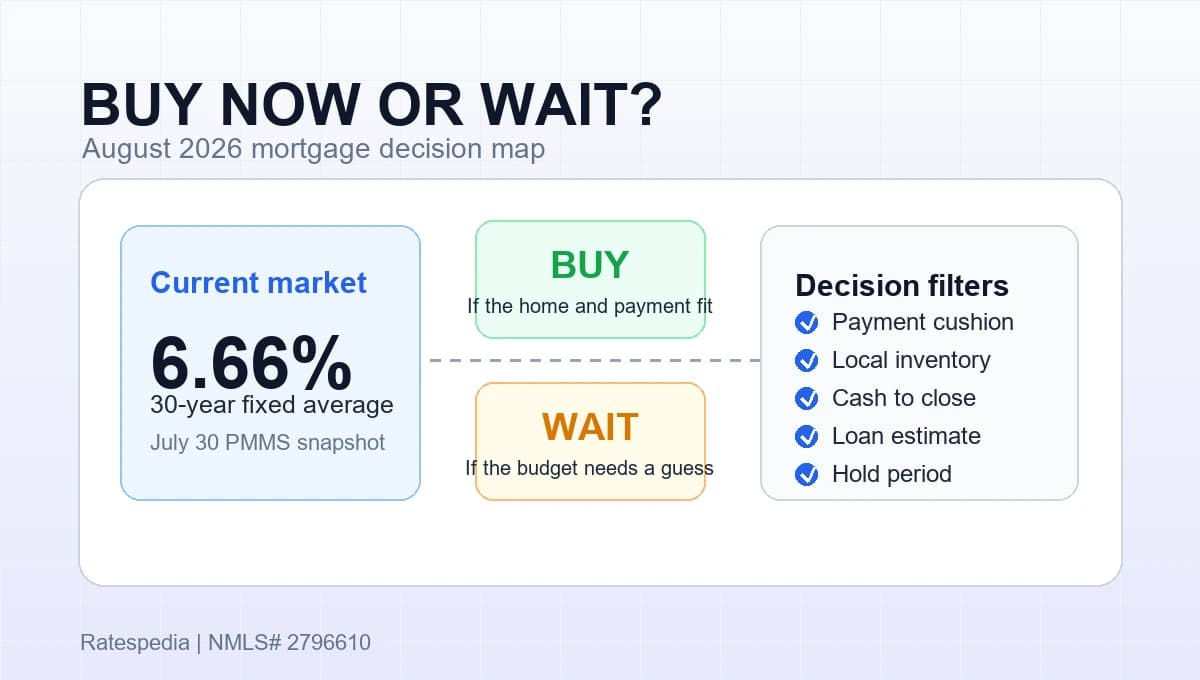
The right answer to "Should I buy a house now or wait?" is not the same for every buyer in 2026. Rates are still high enough to stretch monthly budgets. Prices are still high in many markets. Inventory is better than the tightest years, but not generous everywhere. Waiting may help if your market softens or your finances improve. Waiting can also backfire if the home you want gets more expensive, rent keeps rising, or you lose negotiating power.
As of July 30, 2026, Freddie Mac's Primary Mortgage Market Survey showed the 30-year fixed-rate mortgage averaging 6.66% and the 15-year fixed-rate mortgage averaging 6.04%. The Federal Reserve's July 29, 2026 FOMC statement kept the federal funds target range at 3.50% to 3.75% while saying inflation remained elevated relative to its 2% goal. That mix is why buyers need a budget test, not a guess about next month.
The useful question is not, "Will rates fall?" The useful question is, "Can I buy the right home with a payment I can keep, enough cash after closing, and a plan that still works if rates do not cooperate?"
Key Takeaways
- Buying now can make sense if your payment is comfortable, your cash to close is intact, and local inventory gives you a real choice.
- Waiting can make sense if approval depends on a rate drop, a bonus, a credit-score jump, or a price cut that has not happened yet.
- Freddie Mac's July 30, 2026 PMMS snapshot put the 30-year fixed average at 6.66%, so small rate changes can move the payment quickly.
- NAR's June 2026 data showed slower pending and existing sales, but also a record-high median existing-home price of $440,600.
- Compare actual Loan Estimates, seller credits, points, insurance, taxes, and cash to close before treating any quote as affordable.
- A good buy-now decision should survive without assuming you can refinance soon.
The short answer: buy when the house and payment both fit
Buying now is reasonable when the home is right for at least the next few years, the monthly payment fits your full budget, and you are not relying on a future refinance to make the purchase work.
Waiting is reasonable when the deal only works if something outside your control improves. That might be a lower mortgage rate, a lower home price, more seller concessions, a higher income, a larger down payment, or a cleaner credit file. Hope is not a financing strategy. If the numbers are too tight today, waiting can be the disciplined move.
The best time to buy is not when the market feels perfect. It is when your personal numbers can handle an imperfect market.
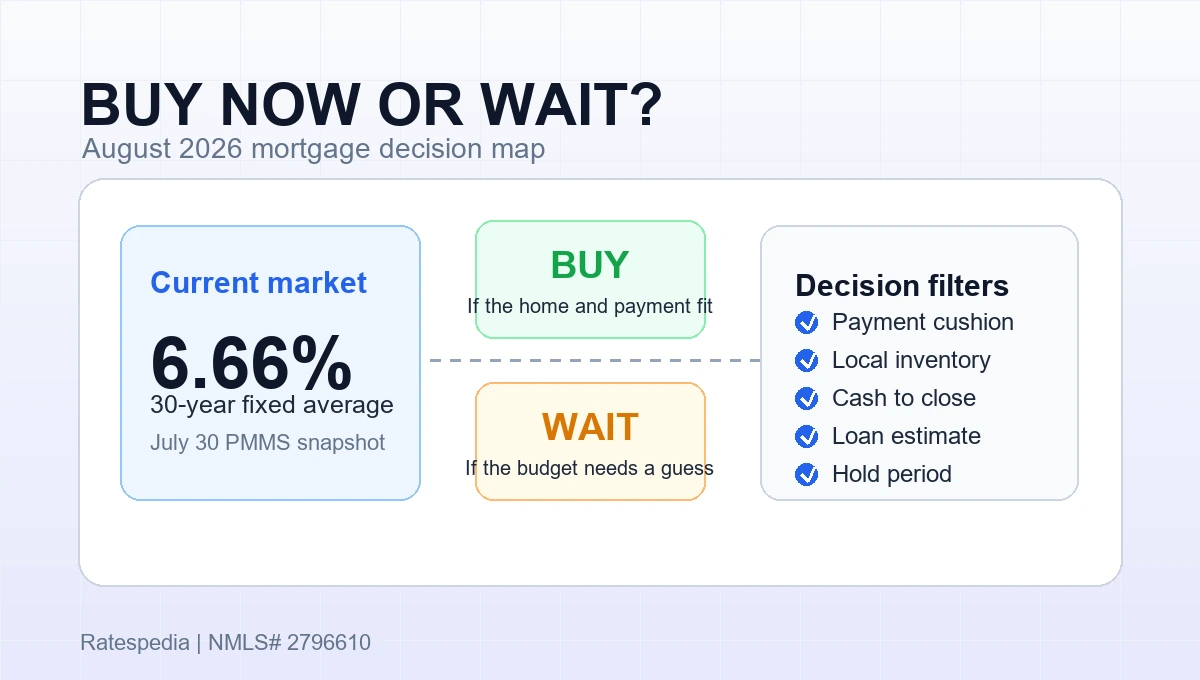
The decision starts with your own file. If you have stable income, manageable debts, verified cash, a strong credit profile, and a home you would keep long enough to absorb transaction costs, buying can be practical even when rates feel frustrating. If your approval is fragile, start with the Ratespedia guide on mortgage credit scores needed to buy a house in 2026 before you shop aggressively.
What the August 2026 market is telling buyers
The national market is sending mixed signals. That is exactly why a simple "buy" or "wait" answer is weak.
Rates are elevated compared with the low-rate years. Freddie Mac's July 30 PMMS showed 6.66% for the 30-year fixed average, up from 6.58% one week earlier. Freddie Mac also noted that the same rate was 6.72% one year earlier, so buyers are not looking at a straight-line market. Rates can move sideways, up, or down in a range that still matters for payment.
The Fed is not promising quick relief. Its July 29 statement kept the federal funds target range unchanged at 3.50% to 3.75%, but it also said inflation remained elevated. Mortgage rates do not move in perfect lockstep with the Fed, but the same inflation and bond-market forces can affect lender pricing.
Housing activity is softer, but prices are not collapsing nationally. The National Association of Realtors pending-home-sales page showed pending home sales down 5.4% in June 2026, with month-over-month declines in all four major U.S. regions. NAR's June 2026 existing-home-sales report showed existing-home sales down 2.4% from May, while the median existing-home price reached $440,600 and inventory stood at 1.56 million units, equal to 4.6 months of supply.
Home prices are still local. The FHFA House Price Index release dated July 28, 2026 said U.S. house prices rose 0.3% in May and 2.2% from May 2025 to May 2026. But FHFA also showed division-level monthly changes ranging from -0.6% in the Pacific division to +1.4% in the East South Central division. A national headline may not describe your neighborhood.
6.66%
6.04%
$440,600
4.6 mo
Why waiting is not automatically cheaper
Waiting sounds safe because it delays a large commitment. Sometimes it is safe. If your down payment is thin, your emergency fund is weak, or your current debt load is too high, waiting can make the eventual purchase stronger.
But waiting is not free. You may keep paying rent without building equity. You may face a higher home price later. A better rate can be offset by less seller flexibility. A larger down payment may be eaten by moving costs, repairs, insurance increases, or another year of rent.
The math becomes clearest when you write down what has to happen for waiting to win. Does the rate need to fall from 6.66% to 6.00%? Does the home price need to drop by 5%? Do you need three more months to raise your score from 699 to 720? Do you need to save another $15,000 so you are not empty after closing?
If the waiting plan is specific, it can be smart. If the waiting plan is only "maybe the market gets better," you may be trading a difficult decision today for an unknown decision later.
How much does the rate really change the payment?
Rate matters because it affects the payment immediately. On a $400,000, 30-year fixed loan, the principal-and-interest payment is about $2,398 at 6.00%, about $2,570 at 6.66%, and about $2,661 at 7.00%. That does not include taxes, insurance, mortgage insurance, homeowners association dues, or closing costs.
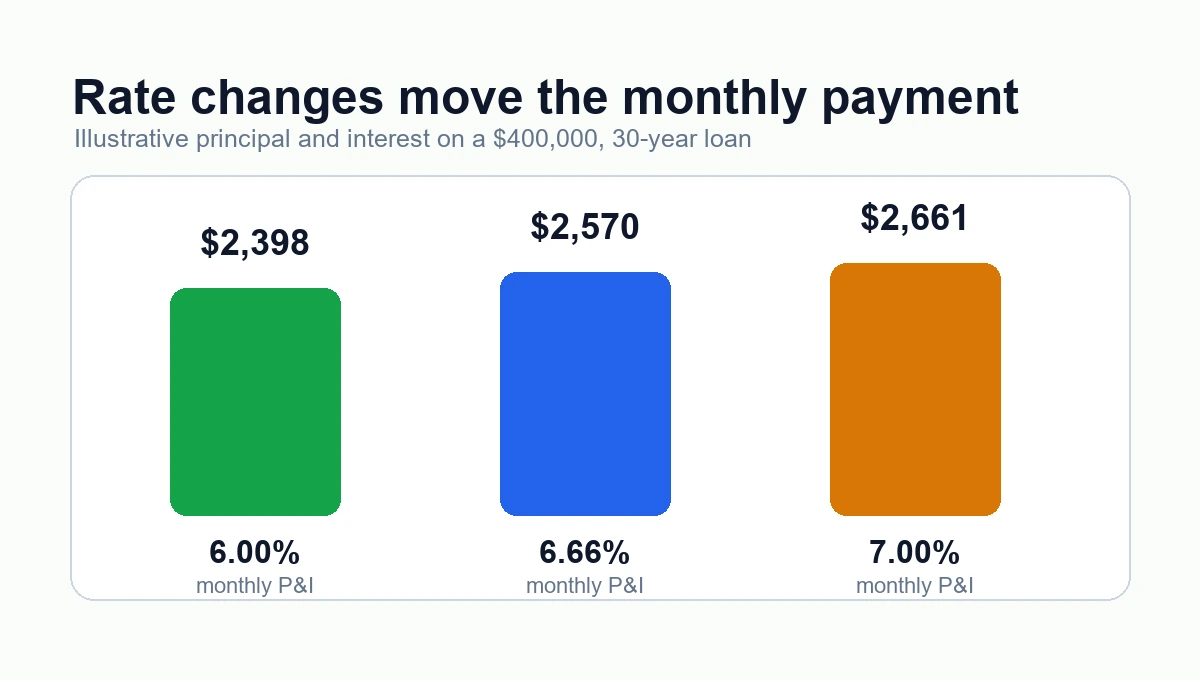
That example shows why buyers are sensitive to small rate moves. A 0.66 percentage point difference from 6.00% to 6.66% adds about $172 per month on that loan amount before escrow items. Over 12 months, that is about $2,064 of cash flow. Over five years, it is more than $10,000 of payment difference before considering principal paydown differences.
The payment is not the only number, but it is the number you live with. If the payment at today's quote already crowds out savings, repairs, utilities, insurance changes, or normal life, buying now may be too tight. If the payment fits with room left over, waiting for a perfect rate may not be necessary.
When buying now can make sense
Buying now can be a good move when your personal situation is stronger than the market feels.
The strongest buy-now case starts with payment durability. That means the full housing payment fits after you include principal, interest, taxes, insurance, mortgage insurance, HOA dues, utilities, maintenance, and a savings cushion. If one normal surprise would put the payment at risk, the home is probably too expensive even if you technically qualify.
The second piece is inventory. A slower market can give buyers more room to compare homes, negotiate repairs, ask for seller credits, or avoid bidding pressure. NAR's June data showed 4.6 months of unsold inventory nationally, but you need to check your local market. Some areas still move quickly. Others give buyers more leverage than they had a year or two ago.
The third piece is time. Buying is cleaner when you expect to own long enough for closing costs, moving costs, repairs, and possible short-term price movement to matter less. If you may relocate within a year, waiting or renting may be smarter.
The fourth piece is structure. Seller credits, discount points, temporary buydowns, and lender credits can all change the upfront cash or monthly payment, but they are not interchangeable. Use the Ratespedia guide on mortgage points vs. seller credits in 2026 before you trade cash, rate, and concessions.
When waiting is the better move
Waiting is not failure. It can be the right move when buying now would create a fragile household budget.
Wait if the only way the deal works is with a lower future rate. Rates may fall, but they may not fall on your schedule. Fannie Mae's July 2026 housing forecast projected the 30-year fixed mortgage averaging 6.4% in the third and fourth quarters of 2026, with forecasts based on rates as of June 30. Forecasts are useful context, not promises.
Wait if your credit file is close to a meaningful threshold. Improving a score, reducing revolving balances, documenting income, or clearing a debt issue can improve your options more reliably than waiting for the market to do the work.
Wait if your cash to close leaves no safety margin. A low-down-payment loan can help, but the down payment is only one part of the closing target. Closing costs, prepaid taxes, insurance, escrow setup, inspections, moving, and repairs still need cash. If cash is the main obstacle, read the Ratespedia guide on down payment assistance in 2026.
Wait if the home itself is a compromise you would regret. A bad location, weak inspection, rushed commute decision, or stretched purchase price can outlast any short-term rate move.
Waiting is smart when it improves your file. Waiting is risky when it only postpones the same unclear decision.
Compare the buy-now and wait scenarios side by side
The cleanest way to decide is to build two written scenarios.
The buy-now scenario should use a real purchase price, current quote, actual taxes, insurance estimate, expected mortgage insurance, likely seller credit, estimated cash to close, moving costs, and post-closing reserves. It should also show what happens if you cannot refinance for three years.
The wait scenario should include rent paid during the waiting period, expected savings added, expected debt reduction, likely credit improvement, possible price movement, and a rate assumption. Be honest. If waiting six months adds $12,000 of savings but you spend $15,000 on rent and prices rise, waiting may not help. If waiting lets you remove debt and buy with a stronger file, it may be the better move.
| Question | Buy now | Wait |
|---|---|---|
| Payment test | Can you afford today's full payment with reserves? | What payment target makes the purchase safer? |
| Cash test | Will you still have money after closing? | How much cash will waiting realistically add? |
| Credit test | Are you already in a strong pricing tier? | Can a specific score improvement lower costs? |
| Market test | Is local inventory giving you enough choice? | Are homes sitting longer or still moving fast? |
| Lifestyle test | Does this home fit your next few years? | Are you waiting for clarity about job, family, or location? |
Ratespedia's resources and calculators can help you pressure-test payments and loan terms before you turn a listing into an offer.
Use actual Loan Estimates, not screenshots or verbal quotes
Once you have a specific home in mind and an accepted offer, compare actual Loan Estimates. The CFPB's choosing a loan offer guide says buyers should request, review, and compare Loan Estimates from multiple lenders. Its compare-and-negotiate guide points buyers to the loan amount, interest rate, principal and interest, mortgage insurance, total monthly payment, upfront loan costs, lender credits, and cash to close.
That matters because a low advertised rate can hide expensive points or a different assumption. A quote with a seller credit can solve cash to close but raise the long-term cost. A lender credit can reduce upfront cash in exchange for a higher rate. A shorter lock may be cheaper but risky if your closing date slips.
Ask lenders to quote the same structure:
The CFPB Loan Estimate explainer is useful because it shows where to find origination charges, services you can shop for, lender credits, estimated cash to close, points, taxes, and insurance. If a quote looks too good, verify the company and the documents before sending sensitive information. The Ratespedia guide Is this mortgage offer a scam? walks through that check.
Do not let the refinance idea carry the purchase
Many buyers hear, "Buy now and refinance later." That can happen, but it should not be the foundation of the purchase.
A future refinance depends on rates, home value, credit, income, debt, property condition, equity, and closing costs. If home values flatten or your income changes, refinancing may not be available when you expect it. If rates drop only slightly, the savings may not clear the break-even period.
Use the Ratespedia guide on whether to refinance your mortgage in 2026 to understand the math. A refinance is strongest when the savings, closing costs, loan term, and expected hold period line up. It is weakest when you need it quickly just to make the original payment bearable.
Consider creative purchase paths, but compare the full structure
Some 2026 buyers can improve the decision with the right structure.
An assumable mortgage may help if the seller has an FHA, VA, or USDA loan with a lower existing rate and a meaningful remaining balance. But assumptions require approval, can create an equity gap, and may take more time. Use the Ratespedia guide on assumable mortgages in 2026 before treating a low seller rate as simple.
Down payment assistance can help if cash to close is the obstacle and the payment still works. Assistance can be a grant, forgivable second, deferred loan, repayable second mortgage, or local program with strict rules. The largest assistance number is not always the best one.
Seller credits can help if the local market gives buyers leverage. A credit can reduce closing costs, fund points, or support a temporary buydown when program rules allow it. But a seller credit does not make an overpriced home cheap. The offer price, appraisal, and full payment still matter.
FHA, VA, USDA, and conventional low-down-payment options can all be valid. The best program depends on credit score, income, property type, occupancy, cash to close, debt-to-income ratio, location, and eligibility. Start with the program that fits your file, then optimize the rate and credits.
A practical buy-now-or-wait checklist
Use this checklist before you let emotion, headlines, or rate predictions decide for you.
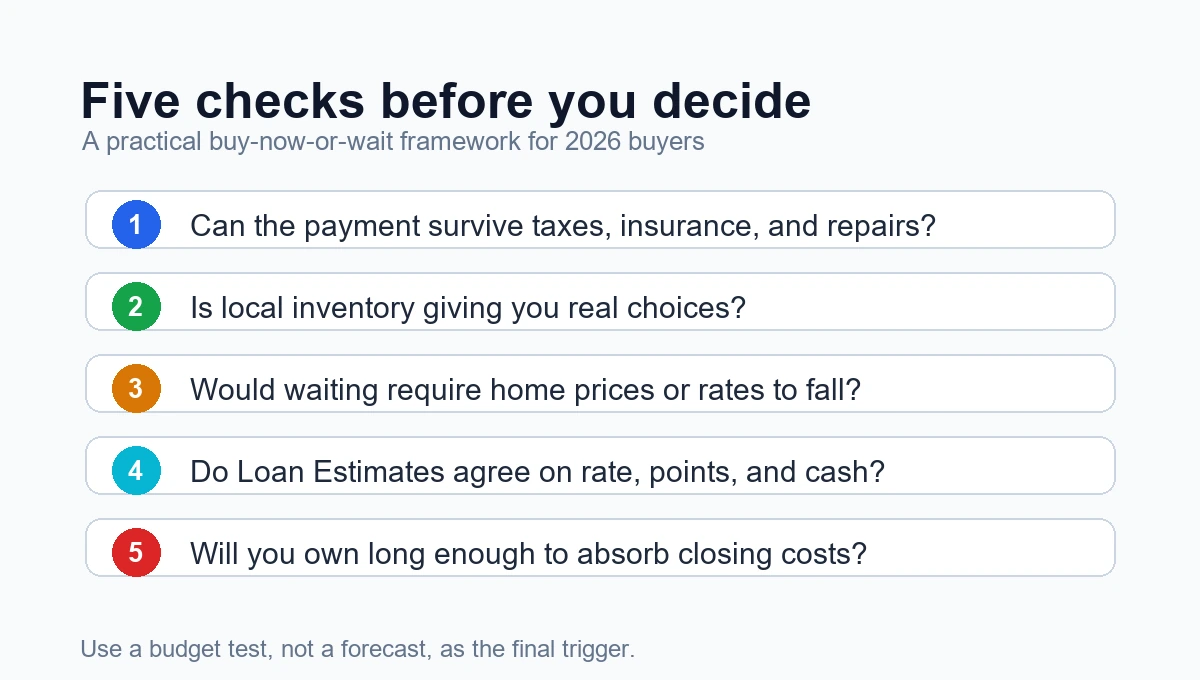
If those checks point to a stable purchase, buying now can be reasonable. If they show that the deal depends on a lucky rate drop or a thin cash cushion, waiting is the cleaner answer.
FAQ: buying a house in 2026
Is 2026 a good time to buy a house?
It can be a good time if your personal numbers are strong and your local market gives you a home that fits. It is not a good time if the payment is too tight, cash after closing is too low, or the deal depends on a future refinance.
Will mortgage rates go down in 2026?
They may move lower, but forecasts are not promises. Freddie Mac's July 30 PMMS average was 6.66% for the 30-year fixed mortgage. Fannie Mae's July forecast projected the 30-year fixed average at 6.4% in the third and fourth quarters of 2026, based on June 30 rates. Your actual quote will depend on market conditions and your file.
Should first-time buyers wait?
First-time buyers should wait when cash to close, credit, debt, or emergency savings are not ready. They should consider buying when the full payment works, assistance options are verified, and the home fits their likely timeline. First-time buyers should be especially careful about repairs and reserves.
Is it better to buy now and refinance later?
Only if the home works without the refinance. A future refinance can improve the deal, but it depends on rates, equity, income, credit, and closing costs. Do not use a possible refinance to justify a payment that is uncomfortable today.
What is the biggest mistake buyers make in this market?
The biggest mistake is comparing a rate headline instead of the full transaction. The monthly payment, cash to close, seller credits, points, taxes, insurance, mortgage insurance, lock terms, repairs, and hold period all need to be reviewed together.
Bottom line
In August 2026, the buy-now-or-wait decision should be personal, local, and written down. National data shows elevated rates, slower sales, more inventory than the tightest years, and still-high prices. That combination creates opportunity for some buyers and risk for others.
Buy now if the home fits, the payment works at today's rate, the Loan Estimate is clear, and you have enough cash after closing. Wait if the numbers only work after a future rate drop, price cut, income change, or credit improvement. The right decision is the one that keeps you in control after closing, not just the one that wins this week's listing.
If you want to verify Ratespedia's licensing before you apply, start with the license page. If you are ready to compare options, the Ratespedia application can help you start with a real mortgage review instead of a guess.
Compare your buy-now and wait scenarios
Use today's payment, cash to close, credit profile, and local market conditions to decide whether buying now is realistic.
Ratespedia LLC is a licensed mortgage broker. NMLS# 2796610. This article is educational and is not legal, credit, tax, or financial advice. Mortgage rates, home prices, inventory, seller concessions, program guidelines, loan limits, insurance costs, taxes, closing costs, and underwriting requirements can change. Review your Loan Estimate, purchase contract, inspection results, and Closing Disclosure before making a mortgage decision.

Written by
Chad Harter
CEO, Ratespedia | NMLS# 2796610
Chad Harter is the founder and CEO of Ratespedia, a licensed mortgage brokerage helping borrowers across the United States find competitive rates and understand their options. With over a decade of experience in mortgage lending and financial services, Chad built Ratespedia to bring transparency and simplicity to one of the most important financial decisions people make. He writes on mortgage markets, personal finance, and borrower strategy.