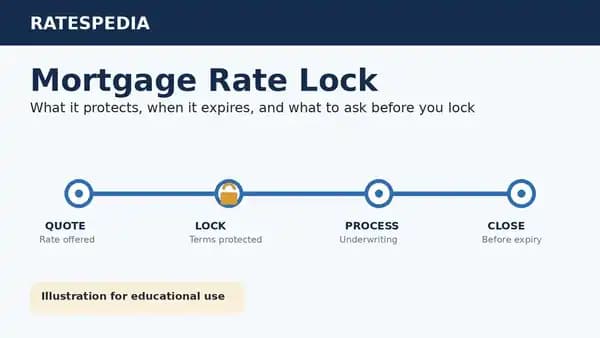
A mortgage rate lock is useful when you are comfortable with the payment you can get today and you want protection from market moves before closing. It does not guarantee that every part of your loan will stay unchanged, and it does not solve a closing timeline that is longer than the lock period.
That distinction matters in August 2026. Mortgage rates have been volatile, and the latest weekly market snapshot reported by the Associated Press showed Freddie Mac's average 30-year fixed rate at 6.69% as of August 6, 2026, up for a fifth straight week. The Federal Reserve had also held the federal funds target range at 3.50% to 3.75% on July 29. Mortgage rates are not set directly by the Fed, but inflation expectations, Treasury yields, economic data, and market risk can move mortgage pricing quickly.
The practical question is therefore not, "Will rates fall next week?" Nobody can answer that reliably. The better question is, "Would I still be comfortable closing this loan if today's rate is the rate I actually get?"
Key Takeaways
- A rate lock generally protects your interest rate between the lock and closing if you close on time and your application does not materially change.
- CFPB says common lock periods are 30, 45, or 60 days, although lenders may offer shorter or longer options.
- A longer lock can provide more schedule protection, but pricing and extension rules vary by lender.
- Your locked pricing can still change if key application details change, including loan amount, credit score, down payment, appraisal, or verified income.
- A float-down option is lender-specific. Do not assume you can automatically take a lower rate if the market improves after you lock.
- Compare lenders using the same rate, point, credit, and lock-period assumptions. A "better rate" is not a better deal if it requires substantially more upfront cost.
The short answer: lock when the payment works and the timeline is realistic
If you are under contract, your lender can close within the lock period, and today's payment fits your budget, locking can remove one important source of uncertainty.
The Consumer Financial Protection Bureau defines a mortgage rate lock as an agreement that keeps your interest rate from changing between the offer and closing, as long as you close within the specified period and there are no changes to your application. CFPB says locks are commonly available for 30, 45, or 60 days, and sometimes longer.
That means a 30-day lock is not automatically "better" because it may be cheaper. If your realistic closing date is 38 days away, a 30-day lock creates an expiration problem before you start.
The best rate lock is not the shortest or the cheapest one. It is the lock that protects the loan through the date you realistically expect to close.
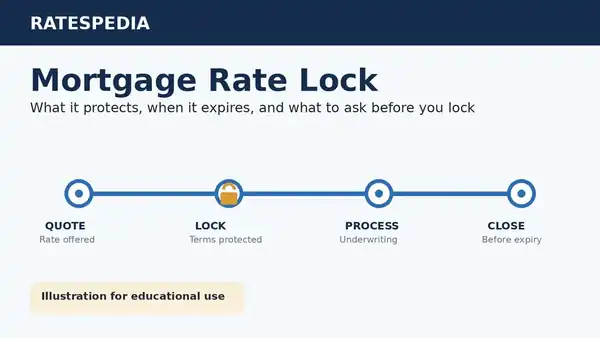
Before you lock, ask your lender for the exact expiration date and time, not just "30 days." Regulation Z requires the Loan Estimate to disclose whether the interest rate is locked and, when it is locked, the date and time the lock period ends. You can see that requirement in the CFPB's Loan Estimate regulation.
What exactly does a mortgage rate lock protect?
A standard rate lock generally protects the interest rate and the pricing tied to that rate for a defined period, subject to the lender's lock agreement and the accuracy of the application information.
It does not mean the loan is approved. CFPB's Loan Estimate review guidance specifically notes that receiving a Loan Estimate, even with a locked rate, does not mean the lender has approved or denied the loan.
A lock also does not freeze taxes, insurance, escrow, title costs, or every other cash-to-close item.
If you are trying to separate rate pricing from total upfront cost, review the Ratespedia guide to closing costs on a house in 2026. A rate lock solves one pricing risk, not the entire closing-cost calculation.
How long should you lock your mortgage rate?
Match the lock to the transaction instead of choosing a duration in isolation.
CFPB says 30-, 45-, and 60-day locks are common. 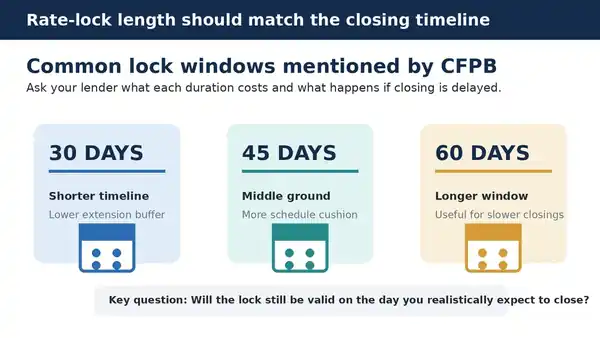
| Lock period | Often fits | Main risk to ask about |
|---|---|---|
| 30 days | A straightforward file already moving toward closing | Little room for appraisal, title, underwriting, or seller delays |
| 45 days | Many normal purchase timelines | Confirm the exact expiration date and lender processing timeline |
| 60 days | Longer contracts or transactions with more moving parts | Ask whether the longer lock changes rate, points, or lender credits |
| Longer than 60 days | New construction or unusually long closing windows | Pricing can differ materially, so compare the cost of certainty |
What happens if your rate lock expires?
If you do not close before the lock expires, the lender may offer an extension, re-lock the loan using current market pricing, or apply another policy described in the lock agreement.
CFPB advises borrowers to ask about extension fees before they lock. Its loan-offer guidance specifically warns that a borrower may have to pay to extend a lock if the closing does not happen on time.
Can your mortgage rate still change after you lock it?
Yes, in some situations.
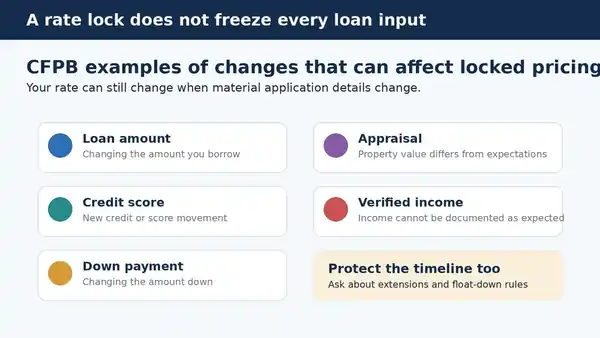
CFPB says a locked rate can still change when important application information changes. Examples include a different loan amount, a change in down payment, a credit-score change, an appraisal that differs from expectations, or income that cannot be documented as expected.
The most avoidable problem is new credit activity. Do not finance furniture, open a new card, miss a payment, or make another large credit move before closing without discussing it with your loan professional.
CFPB's revised Loan Estimate guidance also notes that requesting a rate lock after an initial Loan Estimate can be a legitimate reason for receiving a revised Loan Estimate.
What is a float-down option?
A float-down provision may allow you to take advantage of a lower market rate after you have already locked.
Float-down programs are not universal, and rules differ by lender. They may require a minimum market improvement, allow only one use, charge a fee, or change points and lender credits. Treat a float-down as a contract term, not an assumption.
Ask these questions before you lock:
- Does this lock include a float-down?
- How much must market pricing improve before I can use it?
- Can I use it once or more than once?
- Is there a fee?
- Does it change my points, lender credits, or closing costs?
- When is the last day I can exercise it?
- What happens if rates fall but the lender's specific pricing does not improve enough to qualify?
If the lender cannot explain the float-down in concrete terms, do not treat it as part of the value of the offer.
Should you lock now or wait for rates to fall?
A rate lock is a risk-management decision, not a forecast contest.
As of August 6, 2026, the Associated Press reported that Freddie Mac's 30-year fixed-rate average had risen to 6.69%, the fifth weekly increase in a row and the highest level since July 2025. That is a useful market snapshot, but it does not tell you where your lender's pricing will be tomorrow.
Freddie Mac's Primary Mortgage Market Survey is a national weekly average based on qualifying conventional purchase applications. Your actual quote depends on your credit, loan-to-value ratio, occupancy, property, loan type, points, lender credits, and lender pricing.
The July 29 Federal Reserve decision is not a lock signal by itself. Mortgage rates also respond to Treasury yields, inflation expectations, economic data, and investor demand.
Use this decision framework instead:
| Your situation | Locking is more defensible when | Floating is more defensible when |
|---|---|---|
| Closing in 2 to 3 weeks | Payment works today and you have little time to recover from a rate increase | You can tolerate a higher payment and understand the risk |
| Closing in 30 to 45 days | Lock pricing is reasonable and extension risk is low | You have meaningful budget cushion and a lender-specific float strategy |
| Closing is uncertain | A longer lock is available at acceptable pricing | You are not ready to protect a date that is still likely to move |
| You expect rates to fall | You value payment certainty more than the chance of improvement | You can accept being wrong and paying more if rates rise instead |
Compare the lock, not just the headline rate
A lender quoting 6.50% with two points is not offering the same deal as a lender quoting 6.625% with no points. The lock period can also affect pricing.
Before choosing a lender, compare:
- Interest rate.
- APR.
- Discount points.
- Lender credits.
- Origination charges.
- Lock length.
- Lock expiration date and time.
- Extension policy.
- Float-down policy.
- Cash to close.
The Ratespedia guide to mortgage points and seller credits explains why a lower rate can require more upfront cash. The guide on how to get the lowest mortgage rate covers borrower factors and lender shopping more broadly.
A practical mortgage rate-lock checklist
Before you say "lock it," get the answers in writing.
If you are still deciding whether to commit to the purchase itself, the Ratespedia guide on buying a house now or waiting in 2026 separates the rate question from the broader affordability decision.
FAQ: mortgage rate locks in 2026
How long can you lock a mortgage rate?
CFPB says 30-, 45-, and 60-day locks are common, and longer periods may be available. Availability and pricing vary by lender.
Does a mortgage rate lock cost money?
Sometimes. A lender may include a standard lock in its pricing while charging for a longer lock, extension, or special feature. Ask how the rate, points, lender credits, and fees change with each lock period.
Can I switch lenders after locking a rate?
Switching lenders can restart parts of the loan process and put your closing timeline at risk. You may also lose nonrefundable fees already paid.
What happens if rates drop after I lock?
Your locked rate normally stays in place unless the lender offers a float-down or another repricing option. Ask about the policy before locking because float-down rules are lender-specific.
Can a lender change a locked mortgage rate?
A locked rate can still change when material application information changes or when the lock expires before closing. CFPB lists examples such as changes to loan amount, down payment, credit score, appraisal, or documented income.
Should I lock before a Federal Reserve meeting?
Not solely because a Fed meeting is coming. Mortgage rates are influenced by broader bond-market conditions and expectations, and markets can move before, during, or after a Fed announcement. Base the lock decision on your payment tolerance, closing timeline, and the lender's actual lock terms.
Bottom line
A mortgage rate lock is valuable because it replaces one unknown with a known payment assumption. The tradeoff is that the protection expires, and the agreement may limit your ability to benefit if market pricing improves.
Lock when the payment works, the lender can reasonably close inside the lock period, and you understand the extension and float-down rules. If you decide to float, do it because your budget can absorb a worse outcome, not because you are certain rates will fall.
Use the Ratespedia resources and calculators to compare the payment and total cost before you commit. You can also review Ratespedia's licensing information before starting an application.
Compare mortgage options before you lock
Review the rate, points, lender credits, lock period, and payment together so you can compare complete mortgage scenarios.
Ratespedia LLC is a licensed mortgage broker. NMLS# 2796610. This article is educational and is not legal, credit, tax, or financial advice. Mortgage rates, lock policies, extension fees, lender credits, points, program guidelines, and underwriting requirements can change. Review your Loan Estimate, rate-lock agreement, and final loan documents before making a mortgage decision.

Written by
Chad Harter
CEO, Ratespedia | NMLS# 2796610
Chad Harter is the founder and CEO of Ratespedia, a licensed mortgage brokerage helping borrowers across the United States find competitive rates and understand their options. With over a decade of experience in mortgage lending and financial services, Chad built Ratespedia to bring transparency and simplicity to one of the most important financial decisions people make. He writes on mortgage markets, personal finance, and borrower strategy.